
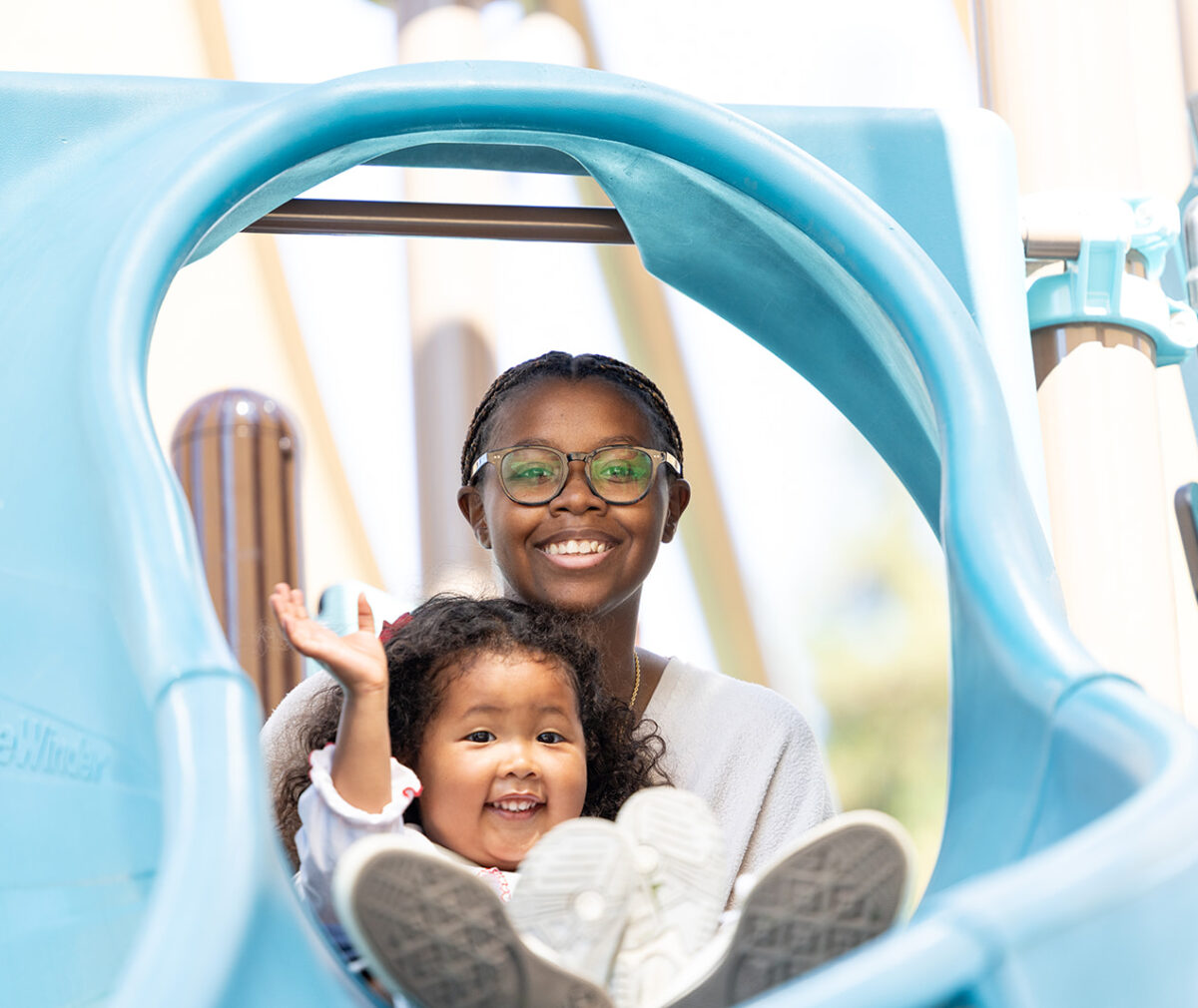
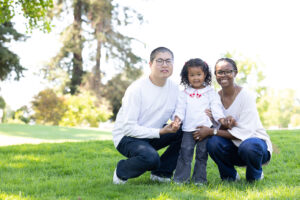
It was day three of Zariah’s induction, and labor was progressing slowly. She was in a single labor and delivery room at មន្ទីរពេទ្យកុមារ Lucile Packard Stanford with her husband, Harrison, who was stationed on the pull-out couch. Everyone was certain there was still time to spare, so her doula slipped out to grab a few things from home—and ended up missing the birth entirely.
Once it began, labor was fast. Baby Azalea arrived at 6 pounds, 3 ounces—“beyond perfect,” Zariah says. “She was the spitting image of my husband.”
Her husband, nervous about hurting Azalea while cutting the cord, was reassured and cheered on by the room’s small crowd of nurses and doctors. “He was cared for as much as I was,” Zariah recalls.
One other person in the room made the day feel complete. Amy Judy, MD, MPH, the high-risk obstetrician (OB) who had guided Zariah through her entire pregnancy, happened to be on call the day of Azalea’s birth. Having her trusted OB in the room felt like more than lucky timing. “It was really special,” Zariah says.
First a Patient, Now a Mother
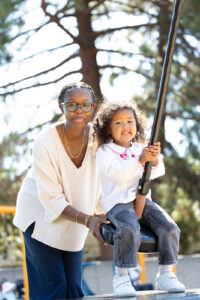
The delivery was smooth and uncomplicated—which had not been a given. Zariah has sickle cell beta thalassemia, a blood disorder that causes chronic pain. For months she’d wondered whether her pain medication might affect the baby she was carrying. And her hemoglobin had run low enough during the pregnancy that Zariah needed two separate hospital stays. Given all that, the straightforward delivery came as a relief.
The birth also closed a loop no one else in the room could have fully understood. Since she was 2 years old, Zariah had received comprehensive care at Packard Children’s Hospital, from pain management and repeated hospital stays to support that helped her keep up with school. Now she was becoming a mother in the same building—and the weight of the moment was not lost on her.
She calls her decision to deliver at Packard Children’s Hospital a “no-brainer.”
“I’ve grown up with this hospital,” she says, “and now my daughter is being cared for here, too.”
For Zariah, the birth, the setting, and her history are entwined: “I will never forget where I gave birth, how I gave birth, who was in the room with me.”
Ready for Every Mom
Zariah’s birth story captures something easy to miss about Packard Children’s Hospital: It is, at once, a community hospital and one of the most specialized maternity programs in the country. Her delivery itself, she says, was “very normal.” But getting there took the close care of a high-risk OB, inpatient stays, specialized monitoring throughout her pregnancy, and a care team fluent in a rare blood disorder.
Zariah’s experience isn’t unique; the numbers bear it out at scale. Roughly 5,000 babies a year are delivered at Packard Children’s, and 70% of those pregnancies are considered high risk.
That volume and complexity have not come at the cost of excellence: Our hospital is ranked No. 4 in the nation for neonatology, and has been recognized for five consecutive years as “high performing” in maternity care by U.S. News & World Report. Additionally, 42% of moms who deliver at Packard Children’s rely on public insurance or Medi-Cal—a reminder that this level of care doesn’t depend on a family’s ability to pay.
Leaders across Packard Children’s Hospital echo the same philosophy of exceptional care for every mom. “We care for patients regardless of their circumstances, from a first-time mother with an uncomplicated pregnancy to the high-risk patient referred here from across the state,” says Yasser El-Sayed, MD, the នាយផ្នែកសម្ភព គ្រួសារ Ford.
Leslee Subak, MD, the Katharine Dexter McCormick and Stanley McCormick Memorial Professor and chair of Stanford’s Department of Obstetrics and Gynecology, describes it in similar terms: “Our goal is to get moms with uncomplicated pregnancies in and out of the hospital with as little intervention as possible. However, in case anything goes wrong, we have every intervention ready at the drop of a hat.”
That readiness was built into the hospital’s original design. When Packard Children’s Hospital opened its doors in 1991, Lucile Packard’s founding vision was to care for mothers and their newborns under one roof—a radical idea at the time, but one that allowed specialists for both mom and baby to be close at hand.
The Next Chapter, Underway
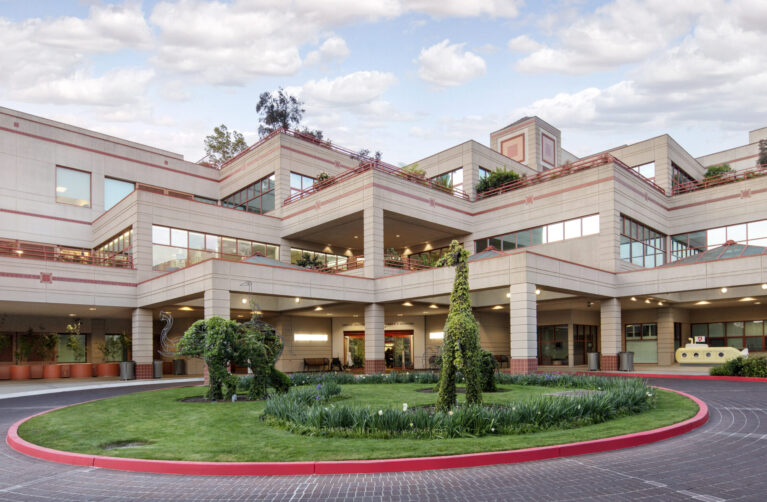
The mission hasn’t changed. What’s changing now is the building itself. When Zariah delivered Azalea three years ago, she remembers the delivery room looking “like a room I stayed at when I was little.” She wasn’t imagining it; much of the West Building has looked the same since it first opened 35 years ago.
The West Building was Packard Children’s original building, and it’s now being completely reimagined. The goal isn’t to change the care already happening—it’s to give that care the space it deserves.
During its ongoing transformation, the West Building remains open and operational and holds fast to what has always set it apart: its warmth and its connection to nature.
The first phase of that work is already finished. The Axe and Blaise Wanstrath Neonatal Intensive Care Unit (NICU) was completed last year, giving NICU families private rooms instead of an open-bay ward—a shift that research shows leads to shorter hospital stays, lower infection rates, and stronger bonds between parents and their babies. The new Dunlevie Maternity Unit has also been completed, and it will eventually serve as an Antepartum Unit for mothers with high-risk pregnancies who need a hospital stay before giving birth.
The next phase turns to creating two other defining spaces that shape families’ very first moments here: Labor and Delivery and the West Lobby.
Big Changes on the Horizon
On the first floor, the brand new Dunlevie Labor and Delivery Unit will include 14 state-of-the-art patient rooms and five triage rooms—enough added space to allow for 20% more deliveries each year—along with three new operating rooms twice the current size. The larger footprint means a full surgical team can move quickly, without the crowding that can come with a complex delivery. Just steps away, a leading-edge neonatal stabilization area can be reached in moments if a newborn needs immediate care. Each operating room will also include separate spaces for mother and baby, since either may need urgent attention right after a difficult birth. All of this will live on a single floor, along with the Antepartum Unit, for the fastest possible transition.
“Whether for normal vaginal births or complicated, emergency deliveries, our teams need the appropriate physical landscape and equipment to work seamlessly together to provide the very best care possible for all our patients,” says El-Sayed.
In total, the spacious and strategically laid out Dunlevie Labor and Delivery Unit will span 28,000 square feet, compared to the previous 12,000 square feet.
The West Lobby is being reimagined just as thoughtfully. The redesigned space will nearly triple in size and serve an estimated 130,000 visitors a year—and, just as importantly, it will sit on the same floor as Labor and Delivery. A mother in labor won’t need to navigate an elevator or a maze of hallways to reach care.
The previous garden was tucked out of easy reach, and staff were often asked how to get there. In the redesigned lobby, the Family Courtyard Garden becomes a seamless part of the space: an inviting place where a sibling can run outside and a family can catch their breath.
Construction on Labor and Delivery and the West Lobby is already underway and on track to be completed in early 2029. Both spaces are being funded in the same way as the new NICU and Antepartum Unit before them: by deeply committed donors investing in their community’s mothers and babies.
Among them are Elizabeth and Bruce Dunlevie. “Bruce and I feel that it is our generational responsibility to ensure new babies coming into the world have the best start in life,” says Elizabeth, who also serves on the Lucile Packard Foundation’s Board of Directors.
See the Fly-Through Videos
To provide a better sense of what’s ahead for the West Lobby and Labor and Delivery Unit, we’ve created two fly-through videos that take you through the spaces.
Full Circle Again
Zariah is thinking now about a second child. She’s begun coordinating timing and medication with her hematologist—the same partnership between hematology and maternal-fetal medicine that carried her through her first pregnancy.
If Zariah has her way, Dr. Judy will be in the room again, too. Ask Zariah what’s kept her coming back for more than two decades, and she doesn’t hesitate: “It’s the people.”
Next time, though, her family might find themselves in a more spacious, modern, and light-filled delivery room—in a building entirely transformed for the families calling it home for as long as they need it.