
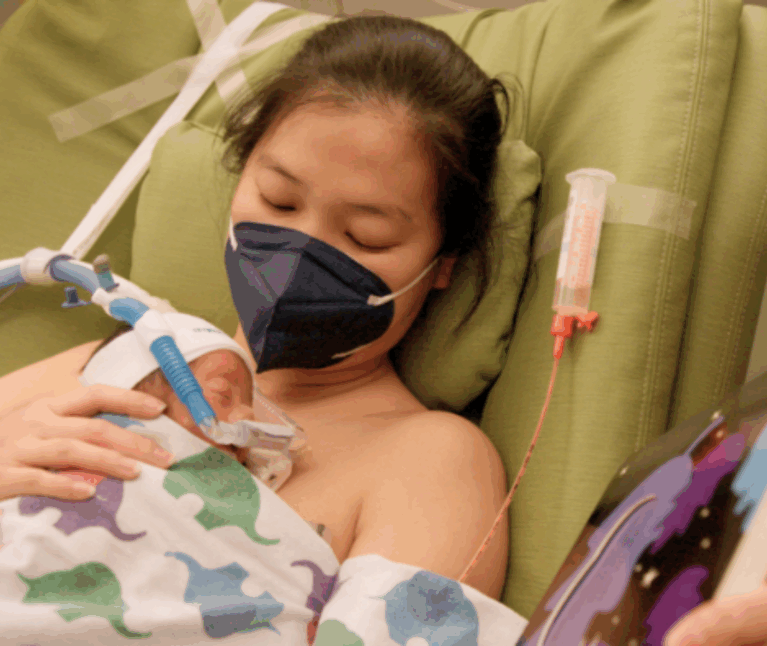
Stanford scientists recently proved what parents have always known: babies thrive on love and connection. In a first-of-its-kind study, premature infants who heard their mothers’ voices daily showed measurable growth in brain areas tied to language development.
The researchers boosted preemies’ exposure to their mom’s voices during hospitalization by playing recordings of the mothers speaking—a total of 2 hours and 40 minutes a day, for a few weeks at the end of the babies’ hospital stays.
“We [saw] very measurable differences in their language tracks,” says study co-author Melissa Scala, MD, a neonatologist at Lucile Packard Children’s Hospital Stanford. “It’s powerful that something fairly small seems to make a big difference.”
Power the Next Breakthrough
Support pioneering research and care for moms and babies.
Fetal hearing begins to develop a little more than halfway through pregnancy, around 24 weeks. Later in pregnancy, more sounds, including mom’s conversations, reach the fetus. At birth, full-term newborns recognize their mother’s voice and prefer the sounds of their parents’ native language to other languages, prior research has shown.
But premature babies often spend weeks or months in the hospital, typically going home around their original due dates. During hospitalization, they ordinarily hear less maternal speech than if they had continued to develop in utero.
Parents can’t usually stay at the hospital around the clock; they may have older children to care for or jobs they must return to. Preemies are at risk for language delays, and scientists have suspected that reduced early-life exposure to the sounds of speech contributes to the problem.
Dr. Scala hopes parents will feel encouraged to learn that voice recordings can supplement in-person visits. “This is a way that—even if they can’t be there as much as they want to—the baby is still hearing them and still knows that they’re there,” she said. “And the parents are still contributing to the baby’s brain development.”
Learn more about this powerful new research.