
Lyndsay lights up when she talks about her 6-year-old daughter, Audrey. “She’s so strong and sassy,” Lyndsay says.
Audrey loves to dance and play dress up. She was Elsa from Frozen for Halloween and joyfully lip syncs to Spice Girls songs. She is spirited, determined, and endlessly expressive.
But for nearly two years, Audrey was in and out of the hospital dealing with a rare and devastating condition that threatened not only her health but her future.
Thanks to extraordinary care at Hospital Infantil Lucile Packard de Stanford, unwavering family devotion, and generous donors who support innovative treatments and family-centered care, Audrey’s story has become one of resilience, love, and hope.
Facing the Unexpected
Audrey was born in Walnut Creek, Calif., healthy and full term. But at just 3 months old, she developed pneumonia. Instead of recovering, she began a cycle of recurring infections and emergency room trips. After months of uncertainty and escalating concern, her family was referred to Packard Children’s Hospital.
That’s where the reality of Audrey’s situation brought Lyndsay and her husband, John, to their knees.
Packard Children’s specialists diagnosed Audrey with primary hemophagocytic lymphohistiocytosis (HLH), a rare and life-threatening immune disorder that causes the immune system to attack the body’s own organs. In Audrey’s case, an extraordinarily rare genetic anomaly caused the disease.
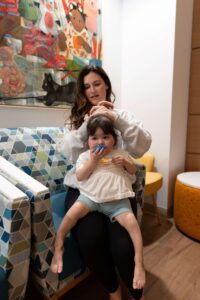
A stem cell transplant was Audrey’s best chance of survival.
“Stem cell transplant, also known as bone marrow transplant, is the main treatment for HLH,” explains pediatric stem cell specialist Orly Klein, MD. “It replaces a patient’s broken immune system with a new one.”
Before she could receive a transplant, Audrey’s care team had to quiet her immune system’s relentless attack using chemotherapy, steroids, and a novel antibody. At just over a year old, she underwent her first stem cell transplant from an anonymous donor.
It did not take.
Her body rejected the transplant, and complications followed: kidney failure, respiratory distress, pancreatitis, insulin-dependent diabetes, and the need for regular hemodialysis.
There were days when Lyndsay and John didn’t know if Audrey would make it.
Stanford experts in stem cell transplantation, nephrology, kidney transplantation, pulmonary medicine, gastroenterology, endocrinology, dialysis, and nutrition came together to bring their best thinking and care to Audrey’s case. It was coordinated, multidisciplinary care at its most urgent and most personal.
And for Lyndsay and John, care extended beyond medicine.
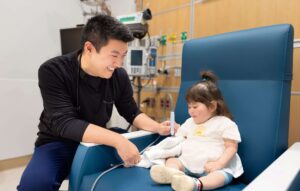
During the hardest times, small routines helped steady the couple. They took daily walks through the hospital halls, stopping to say hello to the small mice statues and admiring the Lego models of iconic Stanford buildings. These moments, however simple, created light in an overwhelming time.
Audrey’s visits from chaplains, child life specialists, and music therapists, along with trips to the hospital library, became anchors.
“Every single day we would look forward to our music therapy time with Emily, stories with Vivian the librarian, and our child life time with Joy,” Lyndsay says. “They made such an impact. They brought smiles into an otherwise very dismal room.”
Over the next six months, Audrey’s care team helped her grow stronger and prepared her for a second transplant.
This time, the Pediatric Stem Cell Transplantation team gave Audrey her mom’s immune system in what’s called a haploidentical (half identical) transplant. Because Lyndsay’s immune cells were genetically familiar, they were less likely to trigger another rejection. The team also used a newly approved chemotherapy regimen that was less toxic, especially important for Audrey’s already fragile kidneys.
“Having that brand-new chemotherapy with less toxicity empowered us to use drugs that were easier on Audrey’s failing kidneys and helped us succeed,” says Klein.
This time, the transplant worked.
“Despite all that has happened, our experience at Packard Children’s Hospital has been wonderful, especially with the critical care team, since we spent her darkest days with them,” Lyndsay says. “But we got close to all of her care teams, who became like family.”
After nearly two years of hospitalizations, Audrey went home with a functioning immune system.
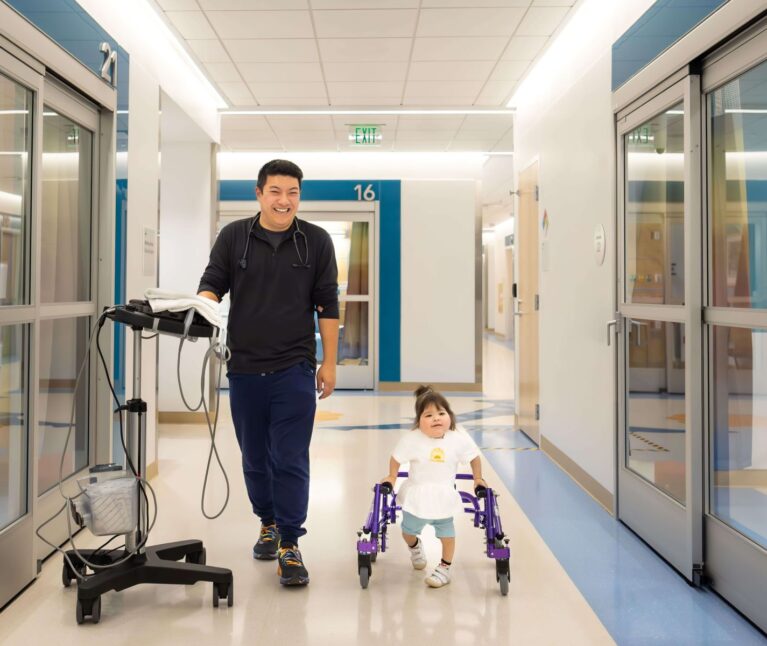
Today, Audrey is 6 years old—though physically she is closer in size to an 18-month-old. She requires hemodialysis treatments four times a week to help her ailing kidneys. Because she is there so often, a teacher joins her to ensure she has an opportunity to learn, even while receiving care. The goal is for her to grow big enough to one day receive a kidney transplant, also from her mother, freeing her from dialysis and opening the door to greater independence.
A philanthropically funded clinical trial supporting patients who receive both stem cell and kidney transplants from the same donor has informed Audrey’s care plan. Research like this, supported by donors, is shaping new standards of care for medically complex children.
Audrey receives ongoing care from endocrinology, nephrology, gastroenterology, and nutrition. Her treatment plan includes a continuous insulin pump, growth hormones, and specialized nutrition support. Through this coordinated approach, she is gaining strength, resilience, and momentum toward her next milestone.
Three years out from her stem cell transplant, Lyndsay describes her daughter as tough. Audrey takes daily injections without flinching. She loves Disney music—of course, “Let It Go” is played on repeat. She dances. She embraces life and adores her baby sister, Vivienne.
“She is the best big sister, so loving and patient,” Lyndsay says.
Her survival has given her parents a new perspective.
“When you’re getting ready to have a baby, you just assume that your baby’s going to be totally healthy,” Lyndsay reflects. “There’s a whole other world for medically complex children that I’ve learned about. It made me want to get involved in a bigger way and bring awareness about families like ours. To express how thankful we are and to give back.”
Why Philanthropy Matters
Audrey’s family now fundraises in support of Packard Children’s Hospital through the Summer Scamper 5k, Kids’ Fun Run, and Family Festival, which draws nearly 3,000 participants to the Stanford campus each year.
For Audrey’s family, Scamper is about gratitude and advocacy. Last year, they turned their experience into hope for others by creating Team Audrey and rallying their friends and family to raise more than $13,000.
“It makes me feel like it wasn’t all for nothing,” Lyndsay says of fundraising. “It’s giving back to a hospital that has been very important to us and is the reason that Audrey is alive.”
On Sunday, June 21, Audrey will be honored as one of the 2026 Summer Scamper Patient Heroes. Come out and join Audrey and her family at Summer Scamper.
Learn more at SummerScamper.org.