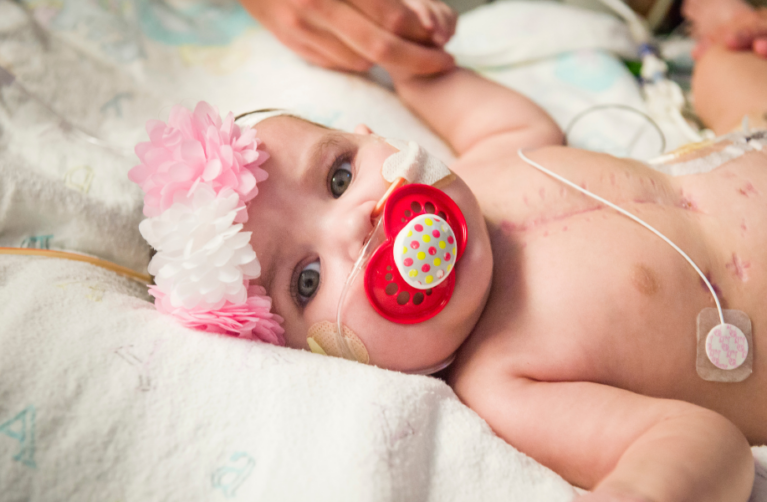

When Hazel was 3 weeks old, she was put on hospice and given six months to live by her Oklahoma doctors. Her parents, Loren and Josh, were devastated.
“We thought, ‘This is it. We are never going to get to see her grow up,’ ” says Loren.
Odds Were Against Her
Hazel was born with a rare combination of heart defects, collectively called tetralogy of Fallot (ToF) with pulmonary atresia and major aortopulmonary collateral arteries (MAPCAs). Together, these defects add up to poor blood flow. Without surgery, babies with severe ToF do not survive.
At birth, Hazel seemed healthy. Twelve hours later, she started turning blue from lack of oxygen. A week later, she received a stent to keep her pulmonary artery open, and three weeks later her doctors started her on hospice and said there was nothing else they could do.
The couple shared the sad news with family and friends. Along with words of sympathy, they received a spark of hope. A friend of a friend reached out and told them to go to Lucile Packard Children’s Hospital Stanford.
“She said her child was given the same diagnosis, and Packard Children’s helped save her,” Loren says.
The couple researched the Betty Irene Moore Children’s Heart Center at Packard Children’s Hospital. They learned about Frank Hanley, MD, the cardiothoracic surgeon who decades ago pioneered unifocalization—a heart-lung surgery that repairs all four defects, often at once. Their hope grew. Maybe Stanford could save Hazel’s life, too.
The Pulmonary Artery Reconstruction (PAR) Program at Packard Children’s Hospital is one of a few places in the nation that has a full team of skilled heart surgeons who perform unifocalization. The team consistently achieves survival rates of 98%, despite caring for children with the most challenging heart defects.
Josh and Loren shared Hazel’s imaging tests and health history with the Packard Children’s team and were told she was a perfect candidate for unifocalization. With much relief, they scheduled the surgery.
The unifocalization surgery involved heart repairs (patching holes and fixing valves), along with reconstructing arteries and blood vessels. Her collateral (extra) arteries, called MAPCAs, were used to create a functioning pulmonary artery to carry blood from the heart to the lungs.
When the surgery was over, Michael Ma, MD, chief of pediatric cardiac surgery, told them exactly what they needed to hear: Hazel did great. She had a full repair and wouldn’t need a second surgery.
“In roughly 90% of patients we achieve a full repair, and in the majority of our patients, we can complete that in one surgery,” Ma says.
Discovering Another Heart Defect
Hazel’s unifocalization surgery was not typical. Instead of having four known heart defects to fix, Hazel had five.
“Unifocalization is a complex operation, but it is relatively routine for us at Packard Children’s. With Hazel, the trickier part was repairing a failing aortic valve,” Ma says.
The aortic valve controls blood flow from the heart to the aorta, the large artery that carries blood to the body. Having a defective aortic valve is rare for children with tetralogy of Fallot with pulmonary atresia and MAPCAs. Fortunately, Ma is pioneering new ways to repair aortic valves in babies, which empower surgeons to customize operations to a child’s exact needs, resulting in better heart function and fewer repairs down the road.
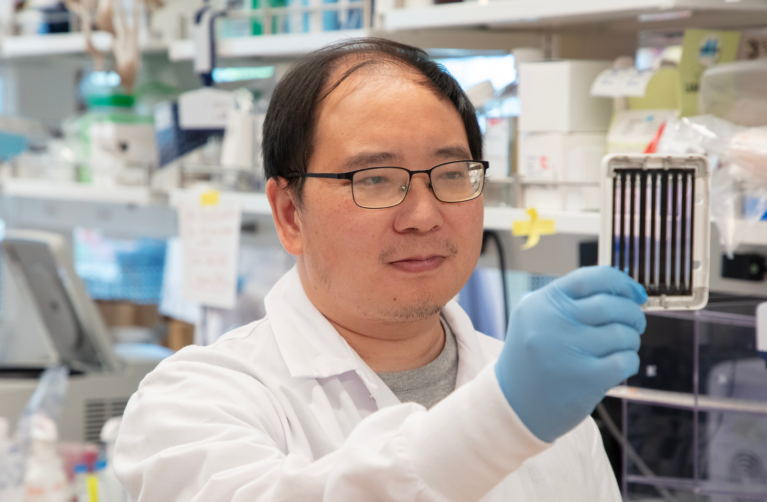
Ma partners with the Stanford School of Engineering’s Cardiovascular Biomechanics Computation Lab, led by Alison Marsden, PhD, to develop advanced technology for repairing complex heart defects, including aortic valves. Marsden is also a member of the Betty Irene Moore Children’s Heart Center’s Basic Science and Engineering (BASE) Initiative, which aims to make the leap from therapies that address the symptoms of congenital heart disease (CHD) to interventions that prevent or cure it.
Hazel was a perfect candidate for a new, exciting research driven approach of mapping out surgery for the best possible outcome.
“We created a 3D design of Hazel’s aortic valve, which included a complex computational fluid dynamic simulation of the way her valve opened and closed, and the ideal geometry of her valve leaflets,” Ma says. “In surgery, we reshaped her aortic valve to match the simulation.”
Ma used Hazel’s own tissue to repair her valve for a better outcome. “When we use non-native tissue, it often deteriorates quickly. It would have meant many more surgeries in Hazel’s near future,” he says.
Hazel is not expected to need another heart surgery in the foreseeable future. The world-renowned PAR Program was able to turn Hazel’s dire prognosis into a real chance at life and give her parents the joy of watching her grow up.
“Dr. Ma and the Packard Children’s team saved Hazel’s life,” Loren says.
Inspired by outcomes like Hazelʼs, board members of the Lucile Packard Foundation for Childrenʼs Health and other generous community members have contributed to support the collaboration between Marsden and Ma—ensuring that more babies with complex CHD can benefit from these advanced simulation techniques.
Loving the Toddler Life
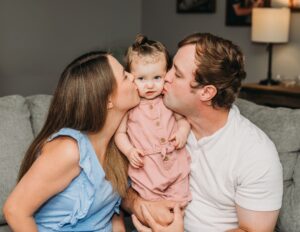
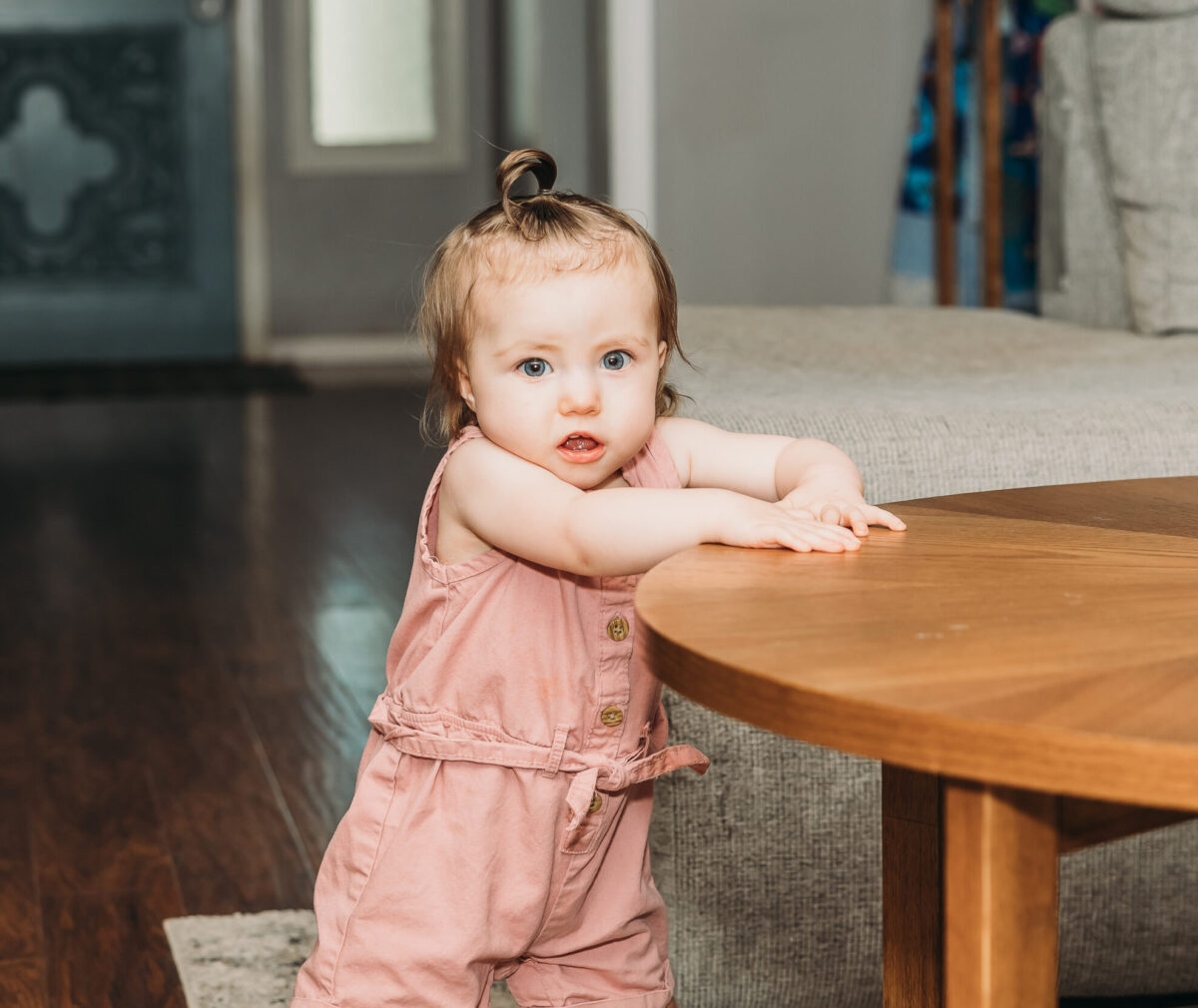
At 1.5 years old, Hazel is doing all the typical toddler things—crawling everywhere, taking her first steps, dancing to music, communicating her desires, and loving her family.
“There was a time we didn’t think we would celebrate her 1st birthday, so we are over-the-moon ecstatic to see her thrive and live her best life,” Loren says.
Hazel loves to play with her big brother, Hudson, and her new baby sister, Hope, who the family aptly named to give tribute to the constant hope they held on to during Hazel’s care journey. Hope also represents the family’s desire for a healthy baby with no abnormalities—a hope that came true.
“Hazel is so funny. When we chase her, she squeals loudly and crawls away fast, giggling,” Josh says. “And she’s a wonderful big sister. The first thing she does when she wakes up is point at Hope, asking to be near her.”
At Hazel’s last heart checkup, her cardiologist said she has excellent blood flow through her pulmonary arteries, and her aortic valve is working well. Best yet, he said her heart function is normal.
“Hearing the word ‘normal’ was so refreshing,” says Josh. “We went through difficult times, but we did not fight alone. We had so many people in our corner, and we are incredibly thankful to everyone who has touched Hazel’s life.”